Behind the Photo: What This Pie Crust Can Teach Your Brand About Food Content

January 29, 2024Content Strategy Tips, Food Photography

When any client brings me a recipe project, my first question isn’t, “What should this look like?” It’s: “What are we selling?”

That question drives every decision, from the angle and lighting to how much of the filling shows and whether the garnish earns its place in the frame. Get the answer right and the image its work. Get it wrong and you have … a pretty photo.

Here’s how it played out on a real project and what it means if you’re a brand commissioning food content.

What is a recipe, really?

The Project: A Frozen Vegan Apple Pie

When the team at Palm Done Right, an international campaign focused on sustainably sourced palm oil, came to me for a series of recipes and images to spotlight their partner brands. One of those was a frozen vegan apple pie.

First, I sourced the pie. Well, several of them. I needed to bake at least one as a tester so I could see what it looked like and how it tasted.

My discovery: Red palm oil has a buttery flavor and rich texture that produces a beautifully flaky pastry crust.

That was the selling point.

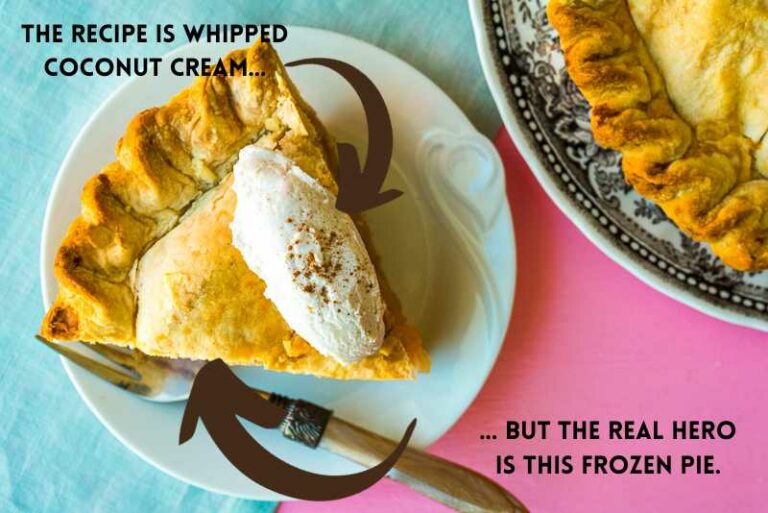
Not the filling (though it was delicious). Not the recipe I was supposed to develop. The hero was the crust on the readymade pie.

So I developed a simple whipped coconut cream as a garnish, something to keep it vegan and easy enough that a shopper reaching for a frozen pie wouldn’t be intimidated. After all, if someone’s baking a frozen pie, they won’t want to spend much time on a recipe to dress it up.

I realized that flaky pie crust needed to be the hero with the recipe almost incidental.

The overhead angle was intentional. It’s the angle that shows the full expanse of that golden, flaky surface. A three-quarter or eye-level shot would have pulled attention toward the filling. Every compositional choice served one brief: Make this crust look like a reason to buy the product.

The result: A tight shot of perfect slice with an off-center dollop of coconut cream, supported by the perfectly crimped whole pie peeking into the frame.

Does your brand really need professional photography?

The Question Behind Every Brief: What Are You Selling?

This is the question I ask every brand before I develop a recipe or plan a shoot. And it’s the question many brands haven’t fully answered when they come to me.

Not because they don’t know their product. But because they haven’t translated that knowledge into a visual brief. It’s the difference between “we sell a frozen pie” and “we’re selling the proof that a vegan pie can have a rich, flaky crust.”

The second version tells me exactly how to shoot it.

Here are the versions of this question I work through on every project:

  • What does the product do that competitors don’t? That’s what needs to be visible in the image. If your tortillas brown beautifully, I need to show that in the image. If your hot sauce has a brightness others don’t, the recipe needs to highlight that in the flavor and the image has to highlight that quality.
  • Who’s buying this, and what will convince them? The Palm Done Right audience needed to believe a vegan pie could satisfy. That meant the crust had to look genuinely golden and flakey, not like a consolation prize. The image had to make a case to a skeptic.
  • Where does this image live? A hero shot for a retailer presentation needs to work differently than an Instagram post or an email header. If you’re building for multiple channels, that needs to be built into the shoot plan, not solved in post-production.
  • Is this a product shot or a recipe image? These look different and they answer different needs. A product shot says, Look for this on the shelf. A recipe image says, Imagine making this. Both are legitimate. The mistake is shooting one when your brief needs the other.

Most brands that have been burned by a shoot that “didn’t feel right” can trace it back to one of these questions going unanswered before the shoot started.

What Does Your Food Photographer Need to Know?

Why the Brief Comes First

I generate the brief as part of my process, which means when a brand hands me a product and a deadline. I come back with 3–5 recipe concepts and a visual direction. The client reacts; they don’t have to author it from scratch.

That’s not a nicety. It’s how you avoid spending $4,000 on images that answer the wrong question.

For the Palm Done Right project, the brief was clear before I tested a single recipe: the crust is the story. Every decision after that – the whipped coconut cream’s role, the overhead angle, the minimal garnish – followed from there.

Want a framework to brief food content that answers these questions?

Download The Content Kitchen Recipe Brief, a free template that walks you through exactly what to specify before your next food content project, so you don’t end up paying for the wrong image or recipe.

Apple Pie Crust with Spiced Maple Coconut Cream

Spiced Maple Whipped Coconut Cream

This rich, vegan whipped coconut cream is an easy garnish for homemade or store-bought pie.
Prep Time 10 minutes
Total Time 10 minutes
Course Condiment, Dessert
Cuisine American
Servings 12

Equipment

  • 1 electric mixer
  • 1 medium bowl

Ingredients
  

  • 1 can unsweetened coconut cream, refrigerated overnight
  • 1 tablespoon maple syrup
  • teaspoon ground cinnamon

Instructions
 

  • Scoop hardened coconut cream that has risen to the top of the can into a medium bowl. (Use the remaining liquid in the can in soups or smoothies or to cook rice.) Use an electric mixer fitted with a whisk attachment to whip the cream until light and fluffy. Whip in the maple syrup and cinnamon. Serve immediately.
  • (Makes about 1¼ cups.)
Keyword condiment, vegan, vegetarian

Stay In Touch!

Subscribe

* indicates required

Intuit Mailchimp

Search Blog

Follow Alison